专业大型劳保工作服定制厂家直销
 咨询热线: 19948039647
专业大型劳保工作服定制厂家直销
咨询热线: 19948039647 
发布:石家庄劳保服装加工厂 时间:2026-06-30 11:46:18阅读:次
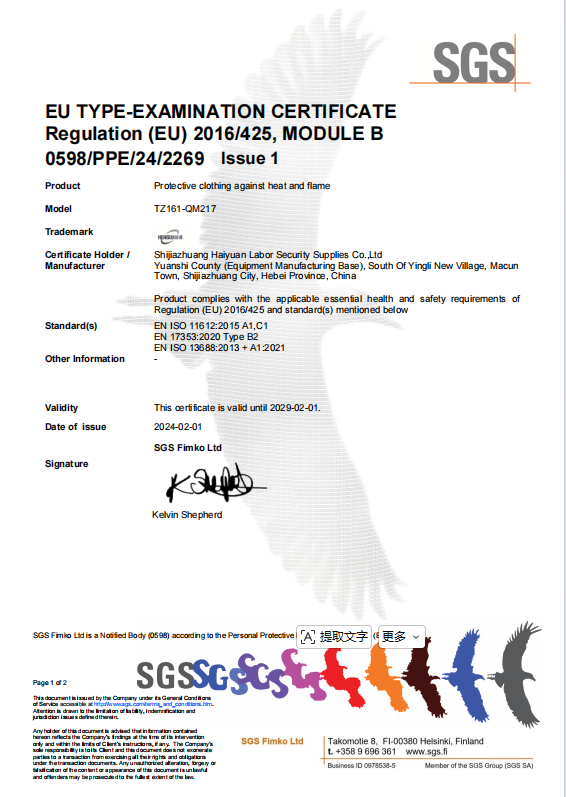
EU TYPE-EXAMINATION CERTIFICATE Regulation (EU) 2016/425, MODULE B0598/PPE/24/2269 Issue 1
Product:Protective clothing against heat and flame
Model:TZ161-QM217
Trademark:henglu
Certificate Holder /Manufacturer:Shijiazhuang Haiyuan Labor Security Supplies Co.,Ltd
Yuanshi County (Equipment Manufacturing Base), South Of Yingli New Village, Macun Town, Shijiazhuang City, Hebei Province, China
Product complies with the applicable essential health and safety requirements of Regulation (EU)2016/425 and standard(s) mentioned below
Standard(s):EN ISO 11612:2015 A1,C1 EN 17353:2020 Type B2 EN ISO 13688:2013 +A1:2021
Other Information –
Validity:This cerfificate is valid until 2029-02-01.
Date of issue:2024-02-01
SGS Fimko Ltd
Signature Kelvin Shepherd
SGS Fimko Ltd is a Notified Body (0598) according to the Personal Protective Equipment Regulation (EU)
This document is issued by the Company under its General Conditions of Service accessible at http://www.sgs.com/terms_and_conditions.htm. Attention is drawn to the limitation of liability, indemnification and jurisdiction issues defined therein.
Any holder of this document is advised that information contained hereon reflects the Company’s findings at the time of its intervention only and within the limits of Client’s instructions, if any. The Company’s sole responsibility is to its Client and this document does not exonerateparties to a transaction from exercising all their rights and obligationsunder the transaction documents. Any unauthorized alteration, forgery or falsification of the content or appearance of this document is unlawfuland offenders may be prosecuted to the fullest extent of the law.
SGS Fimko Ltd
Takomotie 8, FI-00380 Helsinki, Finlandt. +358 9 696 361 www.sgs.fi
Business ID 0978538-5
Member of the SGS Group (SGS SA)
certification standard
EN 17353 is a medium risk environment enhanced visibility equipment standard published by the European Committee for Standardization, officially known as “Protective clothing – Medium risk environment enhanced visibility equipment – Testing methods and requirements”. It specifically targets scenarios with risk levels between high visibility standards (EN ISO 20471) and everyday wear, providing a unified evaluation framework for the visual performance of clothing or devices.
Ⅰ、 Scope of application and positioning
This standard is applicable to enhanced visibility equipment used in medium risk environments, with the aim of making it easier for the wearer to be visually perceived under any daylight conditions, as well as under nighttime vehicle headlights or searchlights. Typical application scenarios include road operations, emergency rescue, logistics warehousing, parking lot management, volunteer services, etc. The level of risk in these scenarios is not sufficient to mandate the use of high visibility clothing that complies with EN ISO 20471, but still requires a certain degree of visual warning.
The standard clearly does not apply to high visibility equipment in high-risk environments, which are governed by EN ISO 20471.
Ⅱ、 Core performance requirements
EN 17353 specifies performance requirements for enhancing visibility equipment from three dimensions:
1. Color performance
The material needs to meet specific chromaticity coordinates and brightness factor requirements to ensure sufficient visibility under sunlight. The testing method for color performance is consistent with EN ISO 20471, but the standard has more flexible requirements for material area.
2. Reflective performance
Reflective materials must meet the specified initial reflective performance requirements to ensure effective reflection of light under nighttime headlights, allowing the wearer to be detected by the driver in a timely manner. The testing of reflective performance also referred to a mature testing method system.
3. Material area and location
The standard specifies the minimum area of visible materials and their distribution positions on equipment. Unlike EN ISO 20471, EN 17353 provides greater design flexibility in terms of area requirements, allowing clothing or devices to be presented in a lighter and more comfortable form while still providing sufficient visual warning effects.
Ⅲ、 Testing method
The main testing items covered by the standard include:
Chromaticity and Brightness Testing
Optical performance testing of reflective materials
Washing resistance test
Dry cleaning resistance test
Abrasion test
Folding and bending resistance test
thermal shock test
Color fastness test
These tests aim to verify that the material can maintain the specified visual performance after repeated use and cleaning.
Ⅳ、 Standard Version and Dynamics
The current version is BS EN 17353:2020, released on October 31, 2020. This standard is currently in a “current, under review” status. In January 2024, the revised draft of the standard 24/30480914 DC was released for comments, indicating that the standard is continuously being updated to reflect the latest risk assessment results and technological advancements.
Ⅴ、 Relationship with other standards
EN 17353 is in the middle of the visual equipment standard system: it is more flexible than the requirements of EN ISO 20471 (high-risk high visual standard), but provides clearer visual performance guarantees than ordinary daily clothing. For work scenarios that require certain visual warnings but do not require reaching the highest visual level, EN 17353 provides the perfect solution.
放眼全球,聚焦行业资讯
返回顶部
19948039647